

When It's Somehow Only You
 Savannah DiMatteo
September 27, 2026 · 7 min read

It was the third unanswered text in the group chat. The one that said, "Mom has a GI appointment Thursday, can anyone take her?" Delivered. Read. Silence. You took her, like you knew you would when you sent it.
Your brother calls on birthdays and has opinions. Your sister lives twenty minutes away and can't handle seeing Mom like this. You can't handle it either, but you do it anyway, which is apparently the difference between you. Somewhere along the way, without a meeting and without a vote, it became settled law: you handle Mom.
If you're looking for someone to tell you it's fair, I can't do that. It isn't.
Why won't my siblings help?
Usually some mix of distance-blindness, denial about the parent, and the family's silent election of one default caregiver. Your siblings see snapshots (the Sunday call, the holiday visit, the version of Mom who pulls it together for company) while you live the film. You see the pill organizer, the night confusion, the appointment schedule she can't track anymore. They get to hold the idea of her as she was because they're not the ones managing the daily reality.
Denial is the other part. If they're not the one managing it, they can keep believing it's not that bad, and the distance lets them stay in a story where everything's mostly fine and you're just being cautious. Showing up more would mean seeing what you see, and that would cost them the version of her they're allowed to keep.
And then there's the silent vote. You drove to the first appointment, so you were the one on the paperwork. The office called you, the pharmacy called you, and each thing made the next thing yours until "you handle Mom" hardened into physics. No one decided it. Everyone relies on it now.
The math never gets even. But some of it is fixable anyway.

How does one person become the whole plan?
You said yes once, and it became the permanent yes. Maybe you live closer, or your schedule looked more flexible, or you're the daughter and daughters just do this. That's what the family's thirty-year pattern whispered without anyone saying it out loud. Maybe you were the one who noticed first, or the one Mom called, or the one who didn't flinch when everyone else found a reason to be busy.
The first yes is a trial period. The second yes is a pattern. By the third, you're the plan, and by the sixth month nobody's even pretending there's a backup.
I'm four years in. It's just me. My brother lives two states away and checks in when he remembers to, and then he has to go. His life kept going. Mine put itself on hold and never came back. I work full-time, manage Mom's pills and appointments and the 4pm restlessness, and field the occasional text from him suggesting I try a different approach he read about. He has thoughts. I have all of it.
Nobody asked if you wanted permanent. You just didn't say no fast enough, and that was enough.

The visits that make it worse
Then there are the ones who show up once or twice a year, stay for the weekend, and spend it auditing your decisions. Why is Mom on that medication? Have you tried getting her out more? She seems fine to me. Of course she seems fine. She's performing for the guest. She saves the hard parts for you because you're the one who's staying.
The Field Guide names the whole cast of them, and you've met every one. The kind you're probably dealing with most: arrives rarely, questions everything, leaves the job exactly where it was.
The worst part is they get to be the fun one. They take her out for ice cream, she lights up, and they think that means you're doing it wrong because they don't see the three hours afterward when the routine is broken and she's agitated and you're the one steadying the ship they tipped.
If that's the visit you're bracing for, here's what you're allowed to do: protect your work. They don't get to reset the routine you spent months building. They don't get a vote without a shift.


What asks actually work on siblings who won't help?
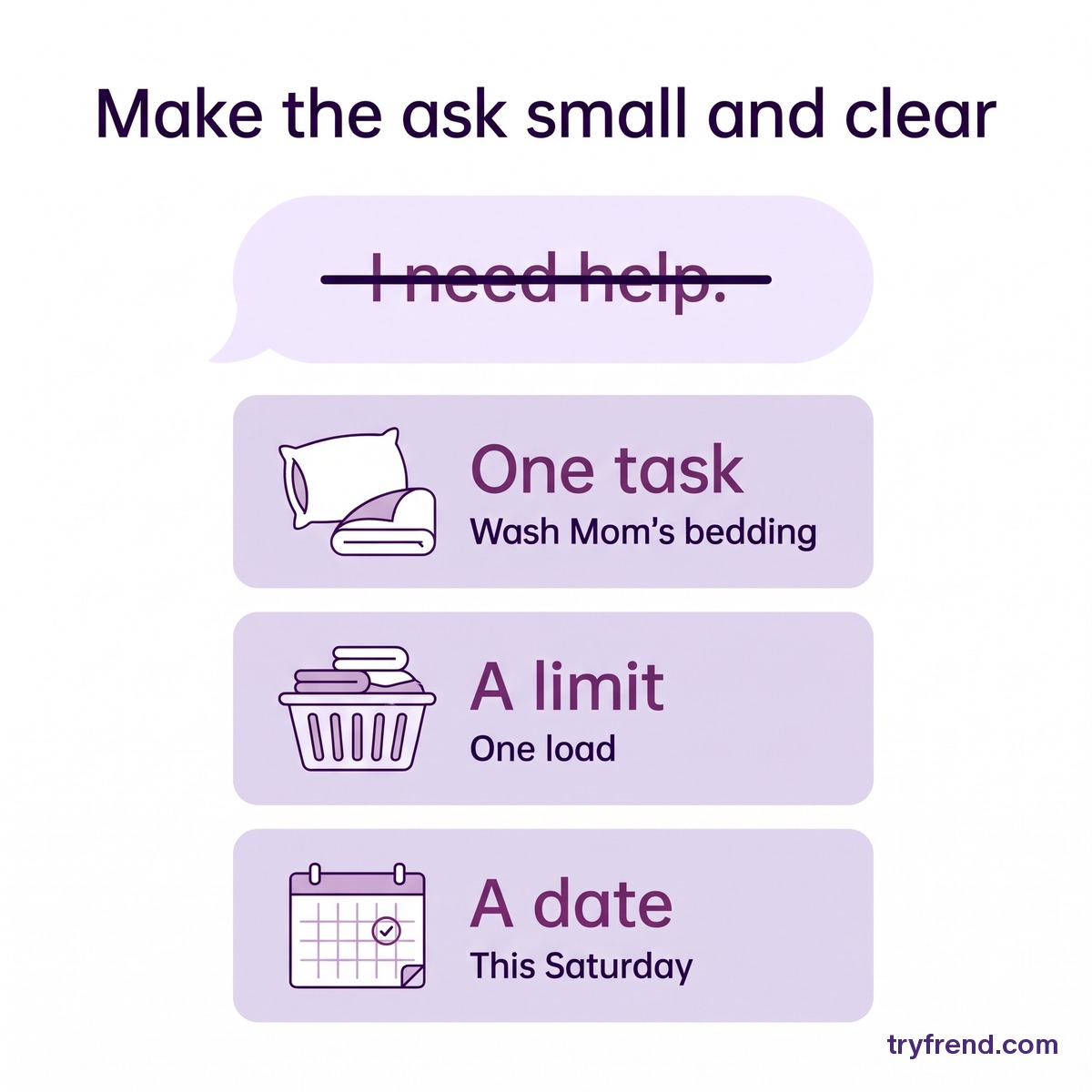
If there's a version of this where they help, it's not the version where you beg them to care as much as you do. That fight is unwinnable. The ask that sometimes works is the one that names one task, puts a boundary on it, and assigns it a date.
Not "I need help." That's a blank check they'll never cash. Try this instead: "Can you handle the pharmacy refills from now on? I'll forward you the login. It takes ten minutes a month." One domain, owned forever. Not hours or fairness or feelings, just this one repeating task that you will never touch again.
Or try: "Mom has a neurology appointment on the 18th. Can you take her? I'll send you the address and the current med list." One calendar square, and whether they say yes or no, you have information about what's actually available to you.
Some siblings will step up if the ask is small enough to say yes to without rearranging their idea of themselves, and others won't, and both answers tell you what you're working with.
The family meeting is worth trying once. The scheduled kind, not the ambush: here's what Mom needs each week, here's what I'm currently doing, here's where I need coverage. If they all say no, you stop asking and you stop expecting. That's triage.
The family meeting kit is free and you can print it at home. Use it to show what the week looks like, what you handle now, and what needs help.
And here's the one nobody wants to say out loud but it's true anyway: money is a substitute for labor, and it counts. If a sibling can't show up but they can send a check that pays for a cleaner twice a month or respite care one weekend, that is a contribution. You don't have to resent it. You're allowed to take it.
What never works: fairness litigation. Rehashing the score, cataloging who did what, presenting evidence of your exhaustion in hopes they'll finally feel bad enough to change. They won't. You'll just lose more nights to a trial you've already won.

What do I do when they still won't help?
If you've asked clearly and they've said no (or worse, said nothing), here's the turn.
Stop invoicing the debt they're not going to pay. You are keeping a ledger of everything they're not doing, and you are right, and carrying it is costing you. The anger is fair. The score is real. But waiting for them to become different people is a second job you've been working for free on top of everything, and you're allowed to quit.
Quitting doesn't mean calling it even or pretending it was fine or forgiving them or handing anyone a clean slate if they show up crying when it's over. The verdict stands, you're allowed to stay angry, and you're just not letting it take your nights anymore.
Grieve the sibling you thought you had and the family that didn't show up. Then protect what's left of the relationship if you want to, or don't. Both are allowed, and if the guilt argues back, the guilt isn't evidence.
Some siblings vanish now and reappear at the end, full of opinions about the estate and questions about the will. You will know what to do with that when it happens.
The part where it's still unfair
This note won't tell you it gets fair. It doesn't. You're going to carry more, and they're going to carry less, and no essay is going to fix the thing where one person becomes the whole plan and everyone else gets to keep their lives.
What I can tell you is that you're allowed to stop fighting to make them see it.
The trial in your head at 11pm has a verdict, and you won. Go to bed.
The two-minute check-in asks what kind of tired you're carrying. Nobody else has asked in a while. That's sort of the point.
There's a longer version of this in the Field Guide. It comes free with any Frend order.
And if you're the sibling reading this because someone sent it to you: they need help, not advice. Specific help. This week. The text they sent wasn't rhetorical. (What to say to a caregiver is a five-minute head start.)
*These statements have not been evaluated by the Food and Drug Administration. This product is not intended to diagnose, treat, cure, or prevent any disease.
Keep reading
All articles
Next article
Saffron vs Melatonin: Which Helps Which Problem?
Saffron vs melatonin for sleep: how they work differently, who each suits, and why the groggy-morning problem sends...
2 min read
Read
Previous article
What Burnout Actually Feels Like
Burnout is exhaustion rest doesn't fix, a fuse shorter than you recognize, and going through the motions on autopil...
5 min read
Read
I Thought Resting Meant I Was Failing
The guilt goes off when you rest, when you ask for help, when you take an hour. It sounds like proof that you're fa...
6 min read
Read